

Accounts receivable for small businesses: a complete guide
For most small businesses, accounts receivable management is not a formal process. It is invoices sent, then checked occasionally, then chased when the silence gets uncomfortable. That gap between what you’re owed and what you have in the bank is one of the most common sources of cash flow stress for any small business billing on credit terms.
This guide covers what accounts receivable actually means for a small business, the three numbers worth tracking, and the seven practices that reliably reduce how long you wait to get paid.
This guide focuses on accounts receivable small business practices, covering what accounts receivable actually means for a small business, the three numbers worth tracking, and the seven practices that reliably reduce how long you wait to get paid.
Accounts receivable (AR) is the total amount your customers owe you for work you’ve delivered but not yet been paid for. It appears as an asset on your balance sheet, which is technically accurate but practically misleading — money sitting in your AR ledger doesn’t pay your suppliers. For small businesses, the core challenge is keeping the gap between delivery and payment as short as possible in the context of accounts receivable small business operations.
Why your AR is probably leaking cash right now
The average small business has around $17,500 in outstanding invoices at any given time. That figure sounds manageable until you add that 47% of small businesses report at least some invoices more than 30 days overdue, according to U.S. SMB surveys — and that’s before factoring in how quickly the odds of collecting turn against you the longer you wait.
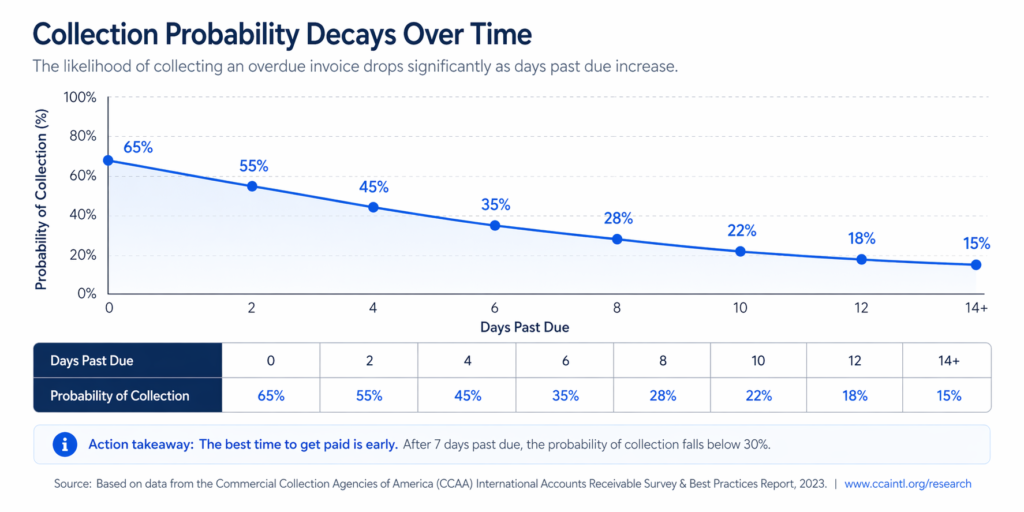
Collection probability deteriorates fast once an invoice ages:
- Within 24 hours of a missed payment: 65% chance of collection
- At 3 days overdue: 45%
- At 7 days: 30%
- At 14+ days: 15%
Source: ResolvePay analysis of B2B collection patterns.
Most businesses do not follow up within 24 hours of a missed payment. Many don’t follow up at day three either. By the time a reminder goes out, they’re already working with unfavorable odds.
The other leak is inconsistency. If your AR process depends on you remembering which invoices are overdue, the ones that slip through tend to be the ones you’d prefer to avoid, with the customers you don’t want to upset, on projects where the relationship matters. That discomfort is normal. It doesn’t make the money less yours.
An 82% of small businesses that fail cite cash flow problems as a primary cause, according to a U.S. Bank study. Most of those businesses weren’t selling bad products. They were waiting too long for money that was already theirs.
The 3 metrics that tell you how your AR is actually doing
You don’t need a finance team to track these. Three numbers give a clear enough picture.
Days Sales Outstanding (DSO)
DSO is the average number of days it takes you to collect payment after issuing an invoice. The formula: (Accounts Receivable ÷ Total Credit Sales) × Number of Days in the period.
A DSO under 45 days is healthy for most small businesses. Under 30 days is good. Over 60 days is a signal your collection process needs attention.
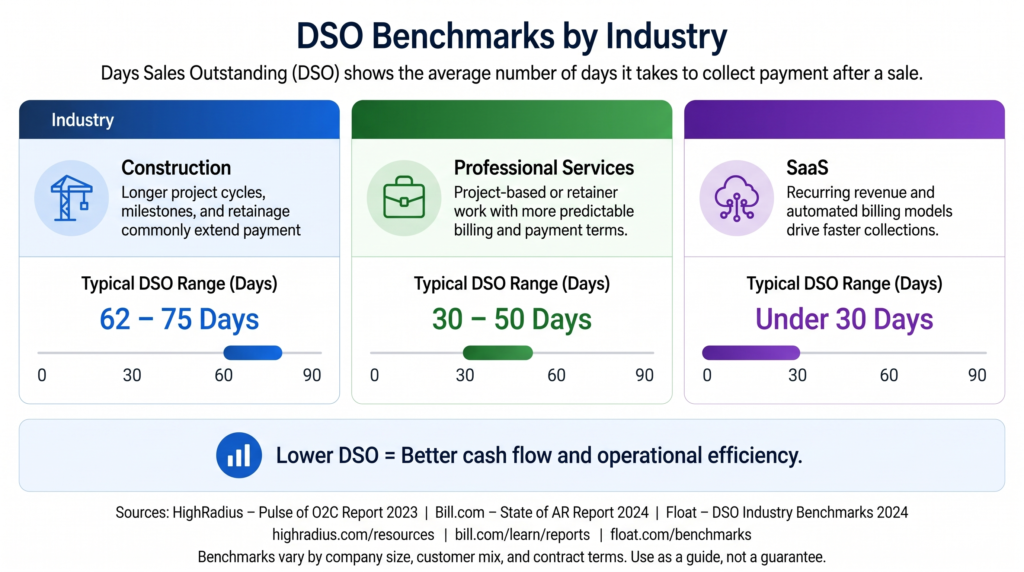
Industry averages vary. Construction sits at 62-75 days because long project cycles and payment practices are baked into the industry. Professional services typically runs 30-50 days for well-managed firms. The specific number matters less than the trend: if your DSO was 35 days last quarter and it’s 49 days this quarter, something changed and you need to know what.
AR aging report
An aging report categorizes outstanding invoices by how long they’ve been overdue: current, 1-30 days late, 31-60 days, 61-90 days, 90+ days.
Run this weekly, not monthly. A monthly review means a 1-30 day overdue invoice can slide to 31-60 before you catch it. Your collection odds at 31-60 days are already significantly worse than at 1-30.
The 90+ days bucket is where your risk is highest. The 61-90 bucket is where you still have decent odds but need to act now.
Collection Effectiveness Index (CEI)
CEI measures what percentage of collectible receivables you actually collected in a given period. A score above 80% is solid. Below 70% means a meaningful share of invoices are not being recovered at all, not just paid late.
DSO tells you speed. CEI tells you what you’re actually getting back.
7 accounts receivable best practices for small businesses
These are the changes that reliably move the needle on getting paid faster.
1. Agree on payment terms before work starts, not on the invoice
The invoice is the wrong moment to introduce your terms. Contracts and proposals are where payment terms get agreed. Customers who see “net 14” on a proposal before work begins are far more likely to pay within 14 days than customers who encounter it for the first time on an invoice they’ve already received.
Net 14 gets you paid faster than net 30, consistently. If you’re using net 30 as a default, it’s worth asking whether that’s because it suits you or because it’s simply what you’ve always done. See our breakdown of which payment terms get you paid faster.
2. Send invoices the day work is delivered
Every day you delay sending an invoice is a day you’ve added to your own wait. Businesses that batch invoices weekly are adding up to seven days of self-imposed delay before their payment terms even begin. Invoice the moment work is delivered.
3. Include clear payment instructions on every invoice
Your invoice should tell the customer exactly how to pay: bank account details, a payment link, or both. A customer who wants to pay but can’t immediately find your IBAN or payment portal will put it in a pile and deal with it later. That delay is avoidable.
4. Run your AR aging report every week
Weekly, not monthly. This is the single habit that most reliably prevents invoices from slipping into the 60+ day bracket without you noticing. It takes less than ten minutes once it’s part of your routine.
5. Send a reminder before the due date
A short, professional note 3-5 days before an invoice is due catches problems before they become defaults. It also signals that you track your receivables, which matters more than it sounds for customers who might otherwise deprioritize a less attentive supplier.
6. Automate the early stages of follow-up
The first reminder at day one overdue, the follow-up at day seven, and the firmer note at day fourteen follow predictable patterns. Automating these three stages means you spend your attention on the accounts that genuinely need a personal approach, rather than manually drafting the same message for the twelfth time.
If you’re doing this by hand and finding it uncomfortable, it’s worth noting that tools exist specifically for this. Chasivo writes invoice follow-ups based on each customer’s payment history and sends them from your own Gmail, so the reminder arrives from your name and email address. You approve every message before it goes out. See the features overview for how that works in practice.
7. Define your escalation policy before you need it
Know in advance what you do at 30 days overdue, at 60 days, and at 90 days. If you’re deciding case-by-case, you’ll unconsciously avoid escalating on accounts where the relationship feels fragile. A written policy removes the hesitation because the decision has already been made.
How often should you follow up on unpaid invoices?
A follow-up sequence that works for most small businesses:
| Stage | Timing | Tone |
|---|---|---|
| Pre-due reminder | 3-5 days before due date | Helpful, professional |
| Due date notice | On the due date | Neutral, factual |
| First overdue | Day 7 | Polite, asks if there are any issues |
| Second overdue | Day 14 | Direct, references late fee policy |
| Final notice | Day 30 | Formal, states next steps |
The tone at each stage matters as much as the timing. Too assertive at day seven damages good relationships. Too passive at day thirty signals that your follow-ups are optional. Getting that calibration right across five different stages is one of the harder parts of manual AR management.
For a full walkthrough of how to write each of these without making it awkward, the guide on how to chase a late payment without making it weird covers the specific language in detail.
When to escalate: formal notices, statutory interest, and collections
Most late invoices resolve before you reach this point. For the ones that don’t:
Send a formal notice at 60 days. A letter on company headed paper stating the amount owed, the original due date, the accumulated late interest (if applicable), and your intention to pursue the debt if unpaid within 14 days. Some customers who’ve been ignoring email reminders respond differently to something that looks like official correspondence.
Know your statutory interest rights. In the UK, the Late Payment of Commercial Debts Act allows you to charge 8% above the Bank of England base rate on overdue B2B invoices, plus a fixed compensation fee between £40 and £100 depending on the debt amount. The EU Late Payment Directive gives similar rights. These charges should be stated in your terms from the beginning — you can’t add them retroactively.
At 90+ days with no response, a commercial debt collection agency becomes worth considering. They typically charge 15-25% of what they recover, which is better than writing the invoice off. Choose one that is a member of the Credit Services Association or an equivalent body in your jurisdiction.
Small claims court is an option for amounts under your jurisdiction’s threshold (£10,000 in England and Wales, which covers most small business invoices). The process is more straightforward than most assume, though it requires the debtor to have assets worth collecting against.
Making AR less painful in practice
Good accounts receivable management isn’t complicated. It requires a consistent process, three metrics, and honesty about which parts of your current setup you’re avoiding.
For a closer look at how to run all of this without a dedicated AR person, the post on accounts receivable without an accounts receivable department covers the operational side.
The businesses that struggle most with AR tend to be the ones where follow-up is manual, irregular, and emotionally uncomfortable. You know an invoice is overdue. You also know the customer and you don’t want to damage the relationship. So you delay, and the odds of collection quietly deteriorate.
Automating the early stages of the process, specifically the reminders that go out before things turn awkward, makes it much easier to stay consistent. When a follow-up goes from your own email address and reads like it came from you personally, it doesn’t feel like harassment. It feels like normal business.
If you want to try that approach, Chasivo’s free plan covers the basics with no credit card required. You can see how automated follow-ups work in practice before deciding if it’s worth building into your process.
The starting point, regardless of tools, is knowing your numbers. A weekly aging report, a rough sense of your DSO, and a clear escalation policy cover 90% of what you need. The rest is follow-through.